1. Industriële Context: Energie- en OPEX-uitdagingen in tropisch Zuid-Amerika
Grote regio's van Zuid-Amerika kennen tropische klimaten, gekenmerkt door hoge omgevingstemperaturen en verhoogde luchtvochtigheid. Nu mobiele netwerkoperators 4G-netwerken uitbreiden en 5G-infrastructuur uitrollen, blijft het totale stroomverbruik per basisstationlocatie stijgen.
In deze omgevingen met hoge temperaturen zetten verouderde AC/DC-gelijkrichters met suboptimale conversie-efficiëntie een aanzienlijk deel van de binnenkomende AC-energie om in afvalwarmte. Deze inefficiënte energieconversie creëert een dubbele straf: verhoogd direct energieverlies en hogere thermische belastingen die ervoor zorgen dat de HVAC- en koelapparatuur van de locatie continu draait, wat de operationele kosten (OPEX) opdrijft. In off-grid of afgelegen gebieden die afhankelijk zijn van dieselgeneratoren, verhoogt een lage gelijkrichterefficiëntie direct de brandstofgebruikstijd en logistieke kosten.
2. Belangrijkste Selectiecriteria: Evaluatie van Hoog-Efficiënte AC/DC-Gelijkrichterstatistieken
Bij het selecteren van stroomapparatuur voor basisstations voor tropische implementaties, moeten telecommunicatieteams gelijkrichters evalueren op basis van conversie-efficiëntie, thermische prestaties en bedrijfstemperatuurbereik:
-
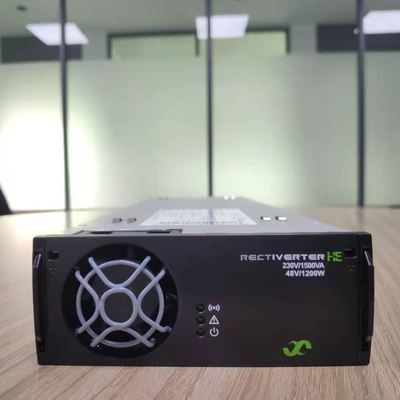
Minimaliseren van Warmteontwikkeling aan de Bron: Het adopteren van Hoog-Efficiënte (HE) gelijkrichtermodules met een conversie-efficiëntie tot 96,5% vermindert het module-energieverlies met ongeveer 50% vergeleken met standaard 90%-efficiënte eenheden. Lagere warmteontwikkeling minimaliseert direct de koellast op de airconditioning van de locatie.
-
Weerstand tegen Brede Temperaturen en Thermische Derating: Temperaturen in buiten geïntegreerde kasten in tropische regio's overschrijden vaak 50°C. Gelijkrichters moeten bedrijfstemperaturen van -40°C tot +75°C ondersteunen. Intelligente thermische derating beschermt de hardware tijdens extreme hitte, waardoor een betrouwbare 1200W output bij 75°C behouden blijft in plaats van plotselinge afsluitingen van de locatie te veroorzaken.
-
Lage Psophometrische Ruis en Nauwkeurige Spanningsregeling: Waar de stabiliteit van het net inconsistent is, vereisen gelijkrichters een strikte statische spanningsregeling ($\pm 0,5\%$) en lage psophometrische ruis ($< 2\text{ mV}_{\text{RMS}}$) om schone, ononderbroken DC-stroom te leveren aan gevoelige radiofrequentie (RF) en basebandapparatuur.
3. Onderhoud en Architectuur: Verlaging van de Levenscyclus TCO via Modulair Ontwerp
Veel tropische telecommunicatielocaties zijn geografisch geïsoleerd, waardoor locatiebezoeken duur en tijdrovend zijn. De betrouwbaarheid en onderhoudbaarheid van de stroomvoorziening hebben directe invloed op de operationele efficiëntie op lange termijn.
Modulaire 48V gelijkrichters met hot-swappable en plug-and-play functionaliteit stellen veldtechnici in staat om live vervangingen of capaciteitsuitbreidingen uit te voeren zonder actieve netwerkdiensten te onderbreken. Gecombineerd met een Mean Time Between Failures (MTBF) van meer dan 350.000 uur (getest volgens Telcordia SR-332 normen), verlaagt deze architectuur de frequentie van locatiebezoeken en de Mean Time to Repair (MTTR), waardoor de Total Cost of Ownership (TCO) wordt verlaagd.
4. Conclusie en Implementatiestrategie
Om de OPEX van basisstations in Zuid-Amerika effectief te verlagen, biedt de implementatie van hoog-efficiënte AC/DC-gelijkrichters een onmiddellijke, meetbare oplossing. Netwerkplanners moeten prioriteit geven aan gelijkrichters op basis van efficiëntiecurves bij typische belastingsniveaus van 30%-70%, thermische derating outputdrempels bij hoge omgevingstemperaturen, en naleving van wereldwijde telecommunicatiestandaarden zoals UL 60950-1 en NEBS.


 Uw bericht moet tussen de 20-3.000 tekens bevatten!